
reed hastings
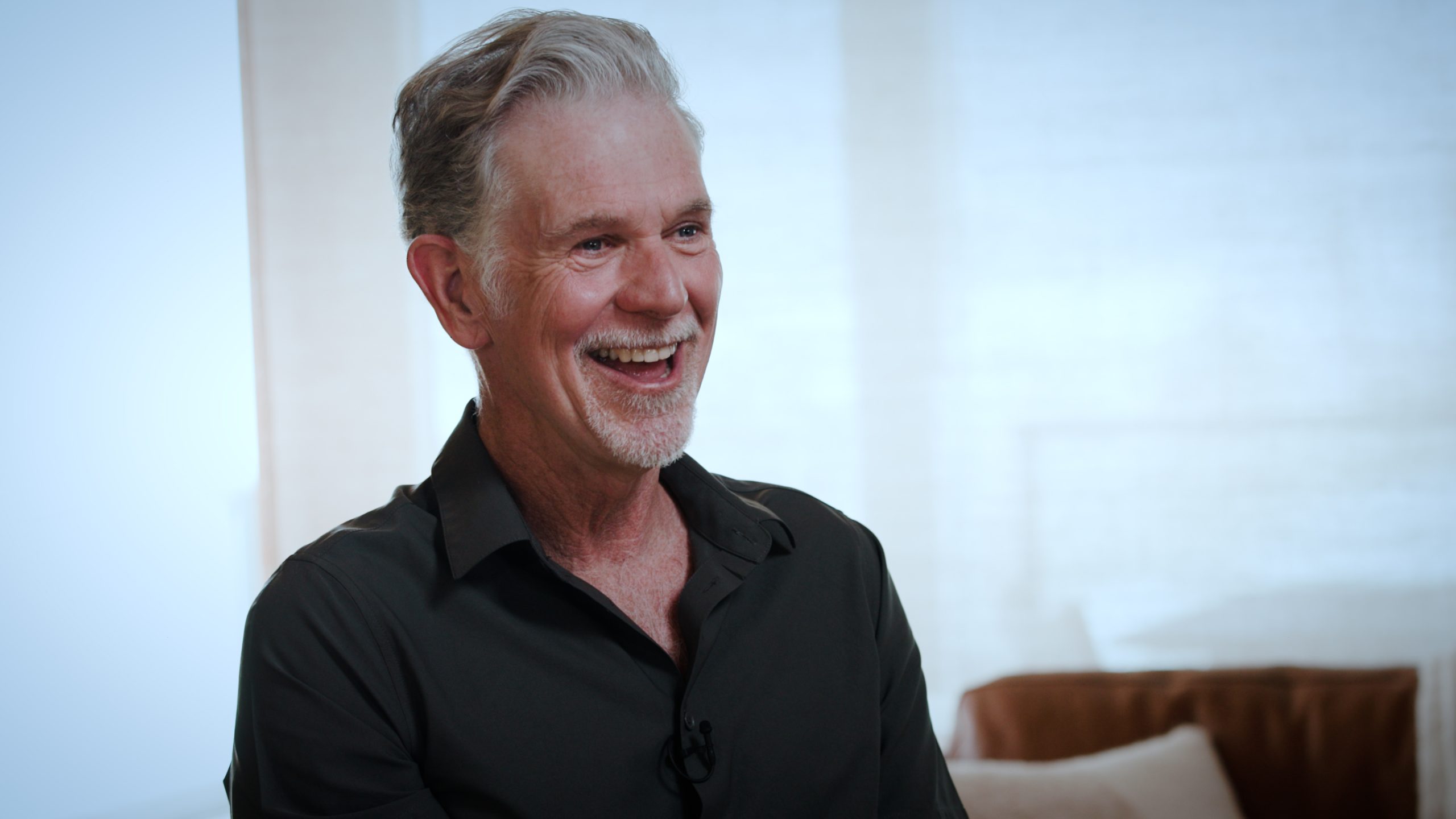
Netflix co-founder Reed Hastings sits down with Graham Bensinger at Powder Mountain, Utah — the ski resort he acquired in just seven days, calling it his “rebound business” after retiring from the company he built for 25 years. From his Peace Corps days in Africa to the Qwikster disaster to the culture that made Netflix famous, Hastings holds nothing back — including the failures he’s never forgotten and the AI threat he thinks could upend everything he built.
reed hastings
CLIPS
Netflix co-founder Reed Hastings: Why I slept outside for 2 years
Netflix founder Reed Hastings opens up about a side of his life most people never see. He lived in a bohemian community called La Honda, sleeping outside on a wooden platform every single night for two years, rain or shine. He recounts a chilling story from his Peace Corps days in Southern Africa, where he casually walked through a game park alone — only to be shown by a warden the large cat tracks that had been following him. Reed also explains why he thinks the popular idea of “work-life balance” is the wrong frame entirely — and what “work-life integration” actually looks like in practice.
Reed Hastings: For $3M you can join my private skiing community
After 25 years running Netflix, Reed Hastings needed a new project — and he found one fast. He bought Powder Mountain ski resort in just seven days, describing the deal as a “rebound business.”. He breaks down his sweeping vision: a 70,000-square-foot clubhouse with bowling alleys, a climbing wall, and a swimming pool; 600 private family memberships; and a couple hundred million dollars invested. He also confesses something rarely heard from a Silicon Valley titan: while running Netflix, he was stress eating and stress drinking — and retirement changed everything.
Reed Hastings: My CEO was washing my coffee cups at 4 AM
Two stories that shaped how Reed Hastings thinks about leadership. First: arriving at the office at 4:30 in the morning to discover his CEO silently washing the dirty coffee cups he’d been leaving at his desk for a year — a quiet act of servant leadership that left a permanent mark. Second: despite Pure Software doubling its sales every year, Reed considers himself a failure as its CEO. He had a new head of sales every single year for six years and couldn’t build the team needed to reach the company’s full potential. He explains how he learned to process failure in a self-improvement mindset rather than a self-destructive one — a lesson that set the stage for Netflix.
Reed Hastings: The broken system behind U.S. education (and why AI could fix it)
Before Netflix, Reed Hastings was a 22-year-old high school math teacher in rural Africa — and that experience never left him. He’s spent decades studying why public education in the US refuses to improve despite more than a century of effort. His diagnosis: the average school superintendent lasts just three years. It’s structurally impossible to fix an organization when leadership rotates that fast. His prescription: charter schools with nonprofit governance for stable leadership, and AI as an individualized tutor that teaches every child at exactly their learning level. He believes we could double the rate of learning for every kid between the ages of 5 and 17.
Reed Hastings’ early entrepreneurship: Cinnamon sticks & vacuum cleaners
Reed Hastings grew up in a stoic New England household where emotions simply weren’t discussed. He describes a childhood where friends were people you did things with — not people you shared feelings with. His father was a lawyer who worked in the Nixon administration; his mother Joan rejected the high society she was born into. He explains what he took from each of them, how he first tasted entrepreneurship by selling cinnamon sticks in seventh grade and vacuum cleaners door-to-door after high school — and why, despite all of it, he never once thought he wanted to be an entrepreneur until he got to Stanford and met people who had actually started companies.
Reed Hastings: Marriage counselor made me realize I was a systematic liar
In a disarmingly candid conversation, Reed Hastings reflects on 35 years of marriage — and what almost derailed it. A marriage counselor in the mid-1990s forced him to confront an uncomfortable truth: he preached that family was the most important thing in his life, but every time a work crisis arose at 6 PM, he stayed. No question. The counselor made him see that he was, as he puts it, a ‘systematic liar.’ He shares the two practical rules that helped him survive a demanding career while keeping his marriage intact — and explains why ‘surprising candor’ became one of the most valuable lessons of his life.
Reed Hastings on the Keeper Test: How Netflix decides who stays and goes
Reed Hastings built Netflix around one of the most controversial workplace philosophies in Silicon Valley: ‘We’re a team, not a family.’ He explains exactly why that distinction matters — and how it justified the ‘keeper test,’ the practice of regularly asking managers whether they would fight to keep an employee if they quit. If the answer was no, that employee was let go with a generous package. It resulted in Roku founder Anthony Wood saying he never worked with a stronger group of people in his life. It also meant demoting his co-founder and firing his head of HR — a close personal friend who had followed him through multiple companies.
Reed Hastings: Why Netflix stopped bidding on Warner Bros.
Netflix made a real bid to acquire Warner Bros. Discovery — and Reed Hastings was genuinely excited about it. He breaks down exactly why Netflix wanted the company, at what price the deal made sense, and why they ultimately walked away when Paramount (backed by Larry Ellison) outbid them. He also shares what surprised him most when Netflix got access to Warner Bros.’ books: just how thoughtful their team was. And he defends the decision not to raise the bid as exactly the kind of price discipline that separates great acquirers from regretful ones — using Google’s purchase of YouTube as a counterexample of when paying up actually works.
Reed Hastings on AI and the biggest risk to Netflix’s future
Reed Hastings takes you inside the two most dangerous moments in Netflix’s history. The first: the Blockbuster wars, when a company 50 times larger than Netflix copied their model, slashed prices, and nearly killed them. The second: 2011’s Quickster disaster, when Reed split the streaming and DVD businesses too early, triggered a massive customer revolt, watched the stock crater, and spent two months hearing calls for his replacement as CEO. He calls himself ‘an idiot.’ He explains what pulled Netflix back — Ted Sarandos producing House of Cards and Arrested Development — and why he finally stepped down at 62, three years after predicting he’d stay another decade.
Reed Hastings: The brutal truth about Facebook’s fall from grace
Reed Hastings spent years at the boardroom table for two of the most powerful companies in technology. He explains how he ended up on Microsoft’s board in 2006: not because he was a top pick, but because most tech leaders competed with Microsoft and were conflicted — and Netflix, as a DVD-by-mail company, was simply not a threat. He reveals how Satya Nadella spent days embedded at Netflix studying its culture before becoming CEO of Microsoft. And on the Meta board for eight years, he watched Facebook’s brand fall continuously despite every effort to reverse it — and says he never saw the light at the end of the tunnel on that particular brand.
Reed Hastings on Anthropic: Dario’s warning about 20% of white collar jobs and mass surveillance
Reed Hastings joined the Anthropic board in 2025, at what he calls an almost incomprehensible moment of growth. He explains what drew him: Dario Amodei’s unusual willingness to talk openly about AI’s scary scenarios, including the possibility that 20% of white-collar jobs could disappear. He also gets into the Anthropic vs. government contract situation: Anthropic declined to sign a government AI deal specifically because it would have allowed mass surveillance of US citizens. When OpenAI stepped in to fill that void, it raised serious questions. Reed shares his perspective on why Anthropic’s commitment to democratic values — even at high financial cost — is exactly what made him want to join.
Reed Hastings on Netflix, Powder Mountain, Anthropic’s AI warning | Full interview
Netflix co-founder and former CEO Reed Hastings sits down with Graham Bensinger for a rare, unfiltered conversation. From the failed Blockbuster pitch to the Qwikster disaster, the keeper test that defined Netflix culture, Netflix’s bid for Warner Brothers, and the marriage counselor who called him a “systematic liar” — Reed holds nothing back. Now retired and building Powder Mountain into a world-class art and ski destination, he also shares his vision for AI in education, lessons from the boards of Microsoft, Meta, and Anthropic, and what drives him at 64.